Building SocketSnake: A Multiplayer TUI Game Written in Rust
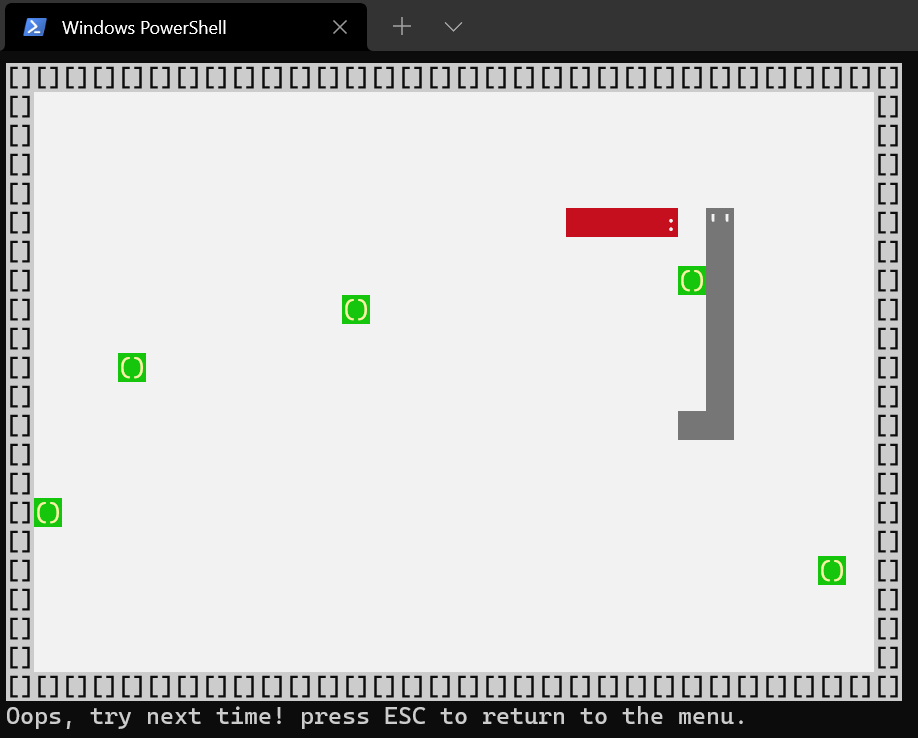
Github repository: SocketSnake
Why snake
I started this Rust project days ago before my assignment for computer networks was due. And also, I though that I shall practice coding after reading half through the book Programming Rust by Jim Blandy, Jason Orendorff. Then the snake was born out of nowhere.
The project is build for personal practice, especially around networks and rust features. Nevertheless, We shall consider if someone would acually play it, right? Or a step forward, if somebody would learn from the project? Thus I write this blog in case of oblivion.
The structure of the project
Everything starts from a easy ground. For building a local version of
the game, while considering that it may be migrated to a networked
version, we implements a Client thread and a
Server thread. The Client thread is
responsible for listening a keyboard action, and convert then into a
Ctrl signal (which is a enum type), and send
it to the Server with a std::mpsc channel; The
Server thread will host an instance of the game
(YardSim), and push the screen buffer YardBuf
(which is a Vec<Vec<TUIBlock>>) to the
Client, who is in charge of rendering the game.
graph TB
    subgraph Client
        Renderer(Render)
        Keyboard(KeyboarCtrlListener)
    end
    subgraph Server
        YardSim(YardSim)--BufferPipe-->Renderer
        Keyboard--CtrlPipe-->YardSim
    end
Moreover, to implement the multiplayer game via network, we shall
develop more modules. The ServerWrapper thread consists the
Server thread, so do the ClientWrapper do.
graph TB

    subgraph ClientWrapper1
        subgraph Client
            Renderer(Render)
            Keyboard(KeyboarCtrlListener)
        end
        Keyboard--CtrlPipe-->TCPSocket1(TCPSocket)
        UDPSocket1(UDPSocket)--BufferPipe-->Renderer
    end


    subgraph ClientWrapper2
        TCPSocket2(TCPSocket)
        UDPSocket2(UDPSocket)
    end

    subgraph ClientWrapperN
        TCPSocketN(TCPSocket)
        UDPSocketN(UDPSocket)
    end

    subgraph ServerWrapper
        TCPSocket1-.Connect.-TCPListener(TCPListener)
        TCPSocket2-.Connect.-TCPListener
        TCPSocketN-.Connect.-TCPListener

        TCPListener-.FireUp.-ClientHandler1
        TCPListener-.FireUp.-ClientHandler2
        TCPListener-.FireUp.-ClientHandlerN

        TCPSocket1==TCPStream==>ClientHandler1
        TCPSocket2==TCPStream==>ClientHandler2
        TCPSocketN==TCPStream==>ClientHandlerN

        ClientHandler1[ClientHandler1]--CtrlPipe-->YardSim
        ClientHandler2[ClientHandler2]--CtrlPipe-->YardSim
        ClientHandlerN[ClientHandlerN]--CtrlPipe-->YardSim


        subgraph Server
            YardSim(YardSim)
        end

        ServerUDPSocket(UDPSocket Multicast)==Buffer==>UDPSocket1
        ServerUDPSocket==Buffer==>UDPSocket2
        ServerUDPSocket==Buffer==>UDPSocketN

        YardSim--BufferPipe-->ServerUDPSocket

    end
In the diagram, the squared blocks are threads, and round-cornered
squares are objects. The bol lines are network channels, and the regular
lines are inter-thread channels. The server wrapper has a
TCPListener: whenever the server listened a connection
request, it launches a ClientHadler thread to deal with the
TCP stream, and send the control signals to the server backend through a
channel. The client then receive the buffer through UDP, and send it for
rendering.
The chioce of a mixure of TCP and UDP is due to the different demands: the control signals need to be sent losslessly and orderly, but the buffer cares more about latency than loosing packets.
Files
The files implementing the project are listed below.
1 | SocketSnake |